Advantages of PROTACs
Introduction
This project proposes the use of PROTAC therapeutics over traditional small molecule inhibitors. But why?
PROTACs are an incredibly exciting novel strategy to target disease-related proteins for degradation, and as such this proposal aims to synthesise PROTACs for the targeting of proteins related to telomerase.
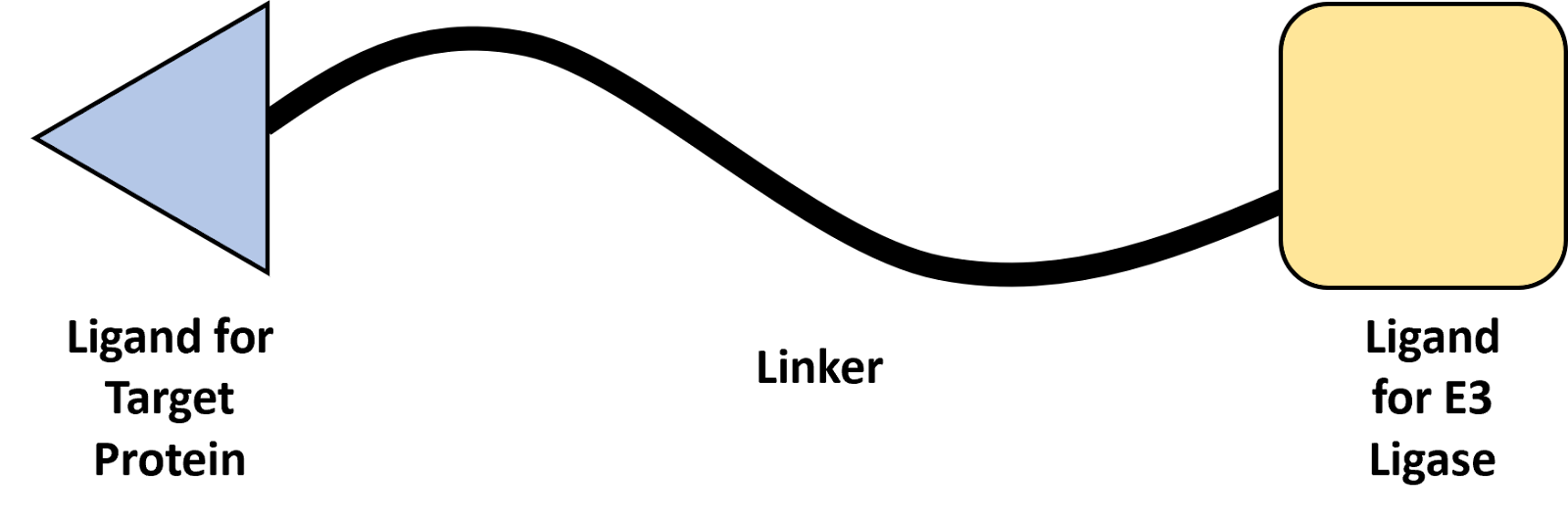
Essentially, they consist of a ligand that binds to the protein targeted for degradation, a ligand that recruits E3 ligase, and a linker that joins these subunits together. This molecule allows the formation of a protein-PROTAC-E3 ligase complex, which induces ubiquitination of the target protein. This eventually leads to degradation of the target protein within the proteasome.
Justification
PROTACs are an especially exciting class of therapeutic because it displays numerous advantages over traditional small molecule inhibitors.
PROTACs can drug ‘undruggable’ proteins: Traditional inhibitors need to bind the target protein in a way that inhibits their function, which leads to ‘undruggable’ proteins without well defined active sites or with complex 3D structures. However PROTACs completely bypass this, because the name of the game isn’t inhibition, but degradation. The linker of the PROTAC just needs to bind, and this can bring the E3 ligase close enough to ubiquitinate and degrade the protein of interest (1).
PROTACs don’t inhibit, they degrade: Another significant advantage of PROTACs degrading rather than inhibiting is that this can lead to a far more sustained and durable effect compared to inhibition. This can overcome or delay the development of resistance (2).
PROTACs degrade catalytically: Traditional inhibitors act stoichiometrically, wherein one inhibitor usually is binding one protein. However PROTAC molecules are released from the ubiquitinated protein before degradation occurs, meaning that it can re-enter the degradation cycle without being consumed. This ‘catalytic degradation’ can lead to a more potent and sustained effect at far lower dosages, and is a huge advantage of PROTACs (2).